
The Gift of Not Knowing: Raising Independent Kids in a Connected World
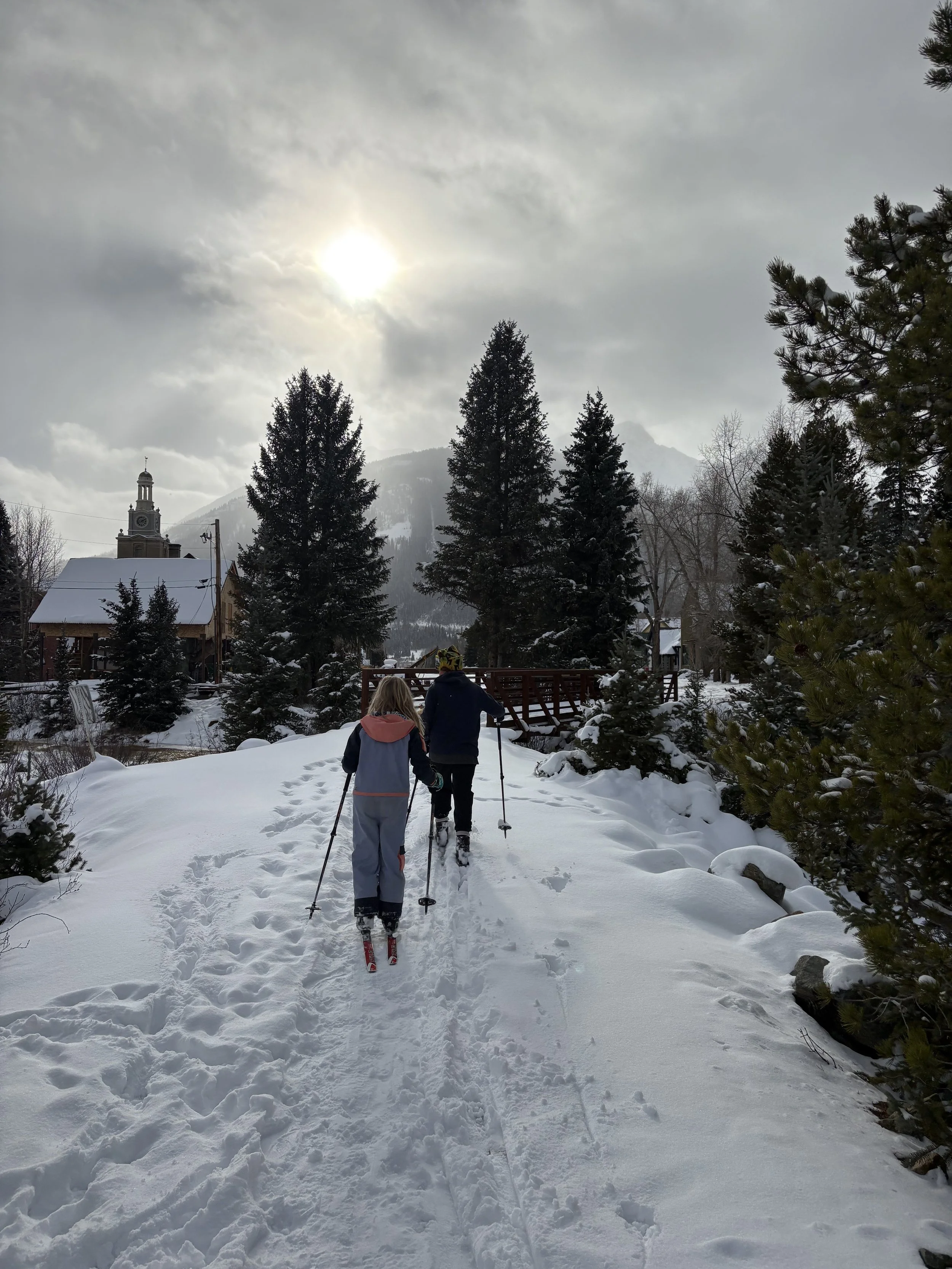
My kids, cross country skiing around town.
I grew up in a time when our parents had very little idea where we were for much of the day.
We rode bikes, wandered through neighborhoods, made up games, got bored, argued with friends, and figured things out. If we wanted to talk to someone, we called their house. On a landline. And if we wanted any privacy, we stretched that curly phone cord as far as it would go or hid in a closet.
And remember calling a boy? You had to call his HOUSE. And potentially speak to his mother first.
The horror.
Remember call waiting? When you could actually interrupt someone else's phone conversation? Revolutionary.
And if we wanted to know something, we looked it up. In an encyclopedia. We had the entire set, and I remember using it!
I'm not suggesting childhood in the 1980s was perfect. But I do wonder what we've traded away in our effort to make childhood safer, easier, and more connected.
I feel incredibly fortunate that I'm raising my three kids in a place that still resembles some of that childhood.
We live in a tiny mountain town with one paved road running through it. My kids know their boundaries: they can't cross that road, and the two playgrounds mark the edges of where they can go.
Within those boundaries, they have freedom.
They ride bikes. They find friends. They make up games. They disappear for a couple of hours without checking in. (I've written before about the joy of missing out, and how sometimes the greatest gift we can give our kids is the freedom to be fully where they are.)
And, God forbid, I don't have a tracker, smartwatch, or iPhone attached to them.
I know this isn't possible for every family or every community. But I also wonder how often we've convinced ourselves it isn't possible without really considering what our kids might gain from a little more independence.
Because here's what I've come to believe after more than 20 years working with young people, and now raising three of my own:
Our children need opportunities to experience life without us watching every moment of it.
This summer, I returned to leading outdoor adventure programs, watching teenagers spend weeks traveling through extraordinary places without their phones.
They talked. They played ridiculous games. They invented inside jokes. They looked out the window. They noticed things. They made friendships with people they might never have approached in their everyday lives.
There was boredom. There was discomfort. There were disagreements.
And there was growth.
But something happened this fall that made me think about unplugging in an entirely different way.
I was speaking with a mother whose son had participated in one of our wilderness trips. She was disappointed that there had been a photographer on his trip.
Now, I'll admit, that's not feedback I hear very often.
Most parents love photographs. We love seeing our kids smiling on a mountain summit, paddling across a lake, or laughing around a campfire. I understand that completely.
But this mom had a different perspective.
She had signed her son up for a wilderness experience. Not an experience where someone was documenting the adventure and capturing beautiful images of him along the way.
She wanted him to have something that was entirely his.
I loved that.
Because in a world where we can track our children, text them constantly, check their grades in real time, and expect photographic evidence of nearly every experience, we've started to believe that knowing more is always better.
But is it?
What if we don't need to know everything?
What if our children benefit from having experiences that aren't immediately shared, photographed, or reported back to us?
And what if we benefit, too?
I think we've become so accustomed to constant access to our children that we've forgotten how to tolerate not knowing.
We want the update. The photograph. The reassurance that they're happy, safe, included, and having a wonderful time.
And when we don't get it, our minds can fill in the blanks.
But part of raising independent children is learning to manage our own discomfort with their independence. I've learned firsthand that the resilience we're trying to build in our children is something we have to practice as parents, too.
Maybe unplugging isn't just about helping kids regulate their attention, emotions, and relationships.
Maybe it's about allowing our own nervous systems to settle, too.
Learning to trust. Learning to wait. Learning that we don't have to intervene, monitor, or receive constant reassurance to be good parents.
Of course: trust doesn't mean ignoring risk, and independence doesn't mean abandoning safety. It's something I've thought deeply about, especially when sending my own children into the world.
Our children need boundaries, responsible adults, and age-appropriate freedom. Wilderness trips need thoughtful risk management and clear ways to communicate when something truly matters.
But there's a difference between keeping children safe and keeping ourselves constantly informed.
I don't think we need to recreate the 1980s. And I certainly don't think we need to throw away our phones.
But perhaps we can borrow a few things from that version of childhood.
A little more freedom.
A little less documentation.
A little more trust.
And maybe, just maybe, we can give our kids the gift of a childhood the gift of a childhood that belongs to them.
Not to our camera rolls.
Not to our group texts.
Not to the little dots moving around on our screens.
To them.
